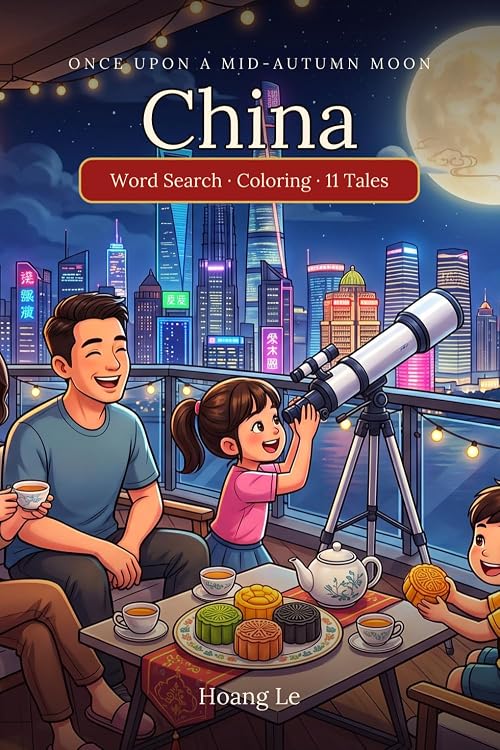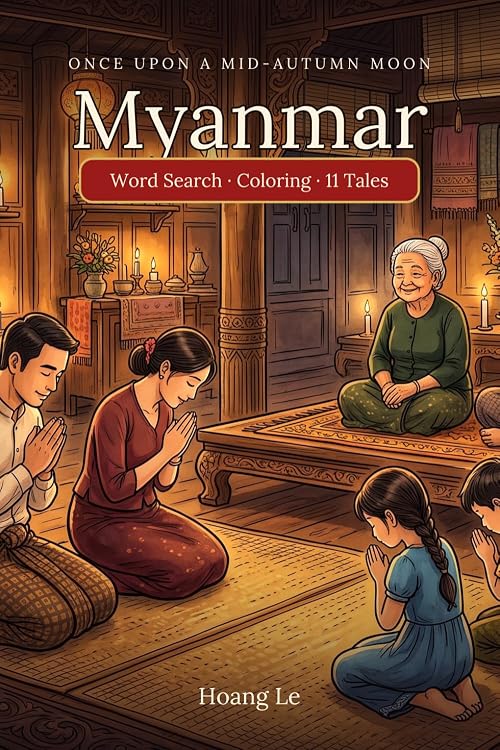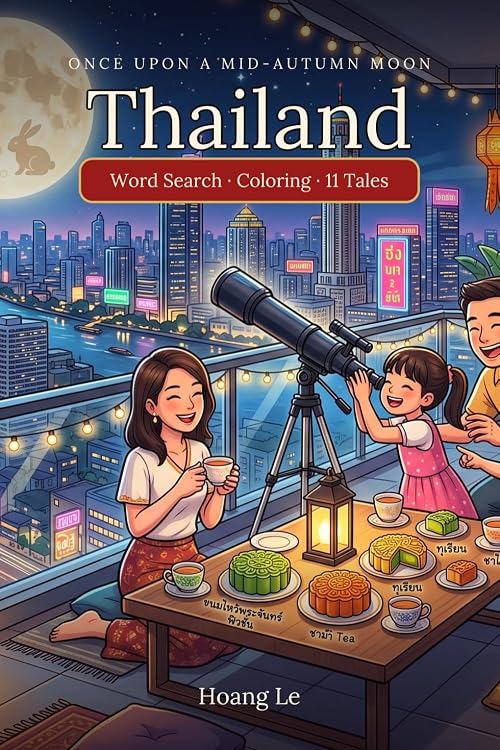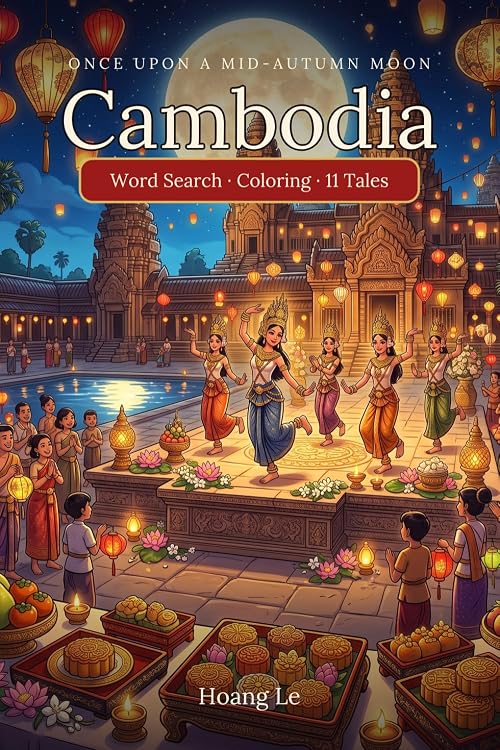
The Mid-Autumn Festival is one of the oldest and most widely kept celebrations in East and Southeast Asia. It lands on the fifteenth day of the eighth lunar month — the night the harvest moon is fullest and brightest — which is why the date moves in the Western calendar each year. In 2026 that night is Friday 25 September 2026.
Underneath the lanterns and the mooncakes, the festival is about one simple idea: the moon is round, families should be round, and this is the night to come back together. That is why so much of it involves circles — round cakes, round fruit, a full moon — and why so much of it is done outdoors, after dark, with children awake past their bedtime.
Where it began: Zhōngqiū Jié in China
The festival is generally traced to China, where it is called Zhōngqiū Jié. Families gather to admire the full moon, share mooncakes, and tell the story of Chang’e, the Moon Lady, who drank an elixir of immortality and floated up to live on the moon — with a jade rabbit for company, endlessly pounding herbs beside her. Lantern riddles are an old part of the night too: a riddle written on a paper lantern, and a small prize for the child who solves it.
The story of Chang’e, the Moon Lady
This is the version most often told. Like every story this old it is told a little differently from one household to the next, and there is no single official text to be faithful to — so what follows is the shape almost all of them share.
Long ago there were ten suns in the sky. They rose together, and under that much light the rivers went dry and the crops burned and nothing could live. An archer named Hou Yi took up his bow and shot nine of them down, leaving the tenth — the one we still have. For saving the world he was given an elixir of immortality: one dose, enough for one person.
He did not drink it. He did not want to go on forever without his wife, Chang’e, so he gave it to her to keep safe, and there it sat. What happens next is where the tellings part. In the gentlest of them, a man came to the house while Hou Yi was away and demanded the elixir, and Chang’e drank it herself rather than let it fall into the wrong hands. She grew lighter, and lighter, until her feet left the floor. She rose past the roof and past the trees and did not stop until she reached the moon.
She is still there. So is the jade rabbit that keeps her company, pounding herbs in a bowl — look at a full moon long enough, children are told, and you can find its shape in the shadows. And Hou Yi, left behind on the ground, set out her favourite fruit and her favourite cakes in the courtyard on the night the moon was fullest, and looked up. Families have been doing a version of that ever since.
Which is the whole festival in one image, really: a night for looking up at somebody you cannot reach, and setting a place for them anyway.
If your child wants the rest of them — the jade rabbit’s quiet promise, the riddle lanterns, the grandmother who would not explain her mooncake — those are the eleven bedtime tales in Once Upon a Mid-Autumn Moon in China, one story a night.
Vietnam: Tết Trung Thu, the children’s festival
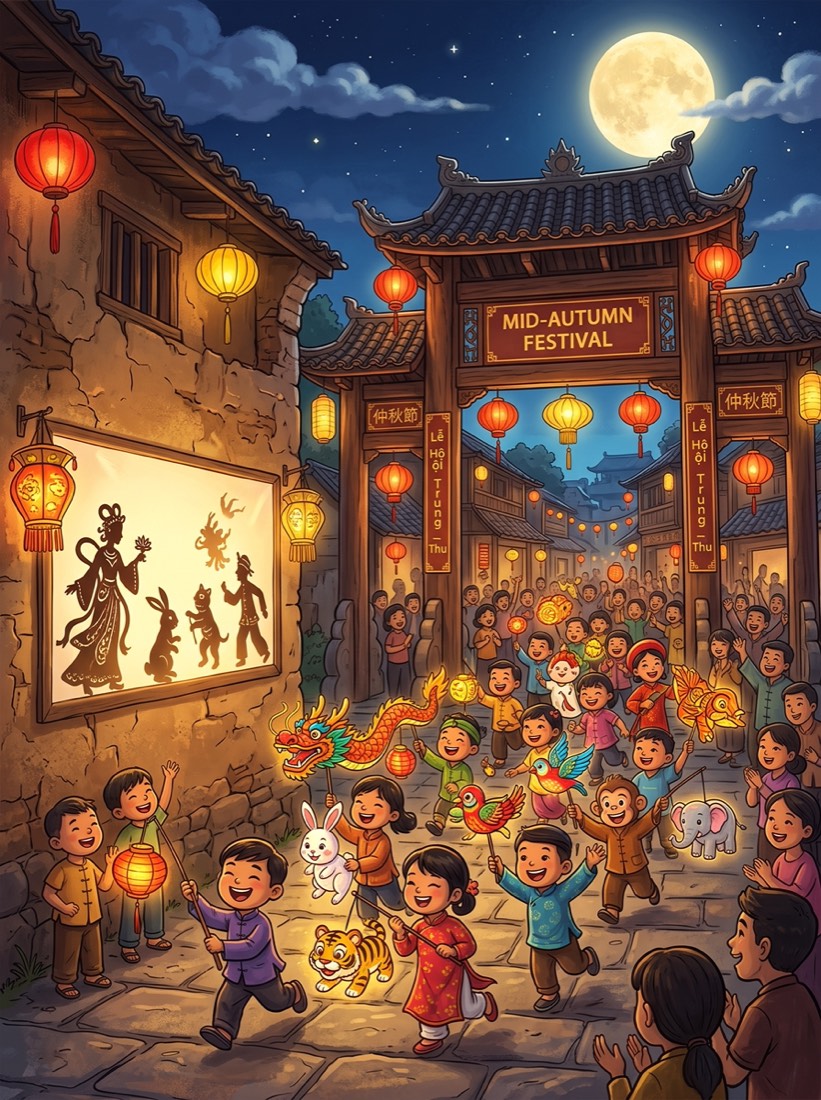
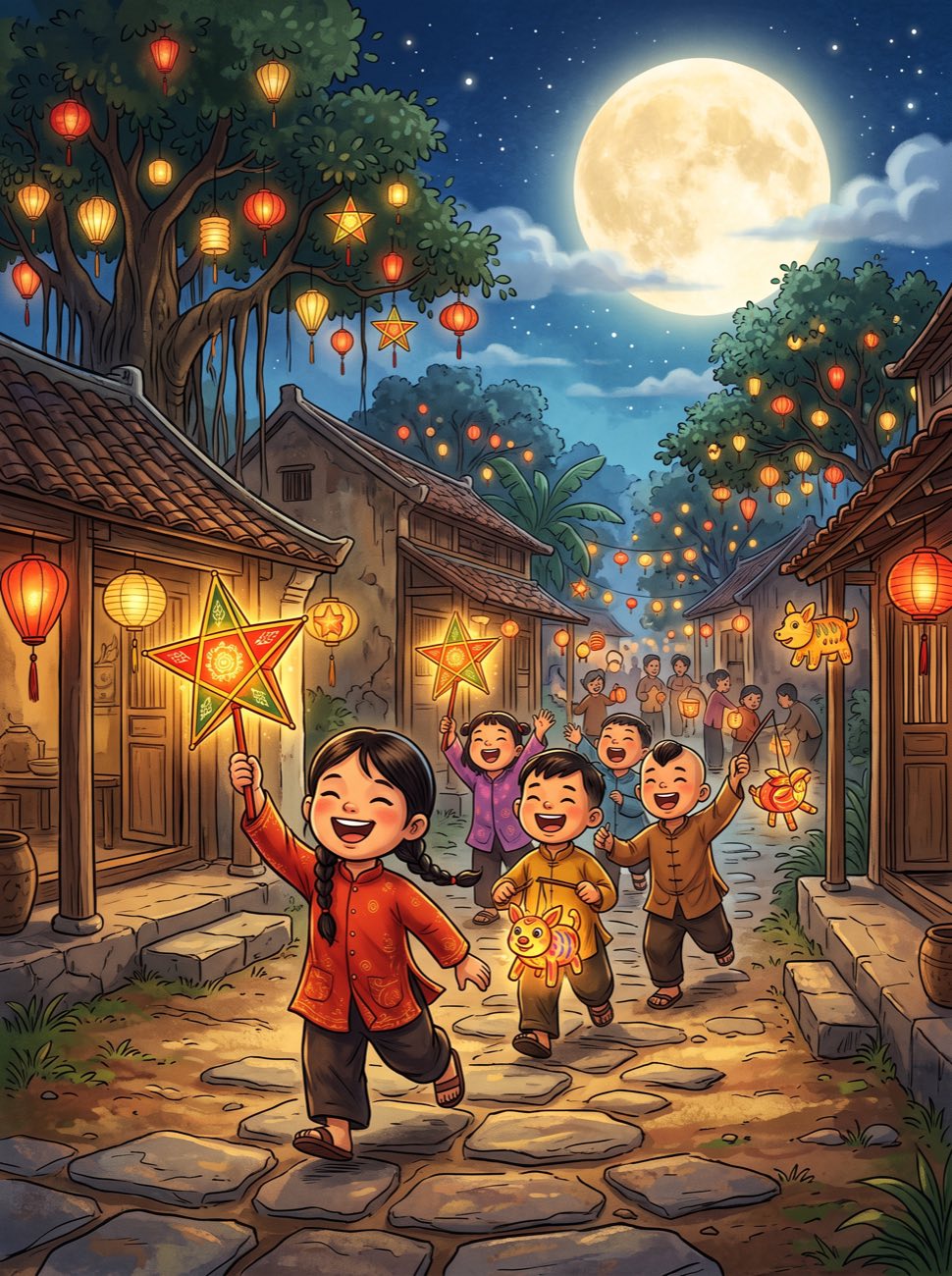
In Vietnam the same full moon is Tết Trung Thu, and it belongs to children more completely than almost any other festival in the region. Children carry đèn ông sao — five-pointed star lanterns on a stick — in processions after dark. Lion dancers, múa lân, move from door to door with drums. And the story told is not Chang’e but Chú Cuội, a woodcutter who held onto a magic banyan tree as it pulled free of the earth and carried him to the moon, where children are told you can still see him sitting.
There is a gentleness to the Vietnamese version that suits small children especially well. Nobody is punished in the Chú Cuội story. He is simply far away, and looking down, and a little lonely — which is exactly the kind of feeling a child can hold without being frightened by it.
The story of Chú Cuội, the man on the moon
Chú Cuội was a woodcutter, and he was not a hero. He was an ordinary man who went out with an axe in the morning and came home in the evening, and the only remarkable thing that ever happened to him happened by accident.
One day, deep in the forest, he found a banyan tree whose leaves could heal. Not soothe a scratch — heal. So he dug it up, carried it home and planted it in his own garden, and after that people came to his gate when somebody in the family was badly hurt, and went away again with a leaf, and the person got better.
The tree came with one rule. It had to be watered with clean water, and only clean water, and never anything else.
Every telling handles what happened next a little differently, and none of them make anyone the villain. The rule was broken — carelessly, in most versions, by someone at home who did not know or did not think. The tree felt it. Its roots came loose from the soil and it began to lift, slowly, the way a boat lifts off a sandbar. Cuội came running and caught hold of it, and held on, and the banyan carried him up past the roofs and past the hills and did not stop.
He landed on the moon. He is said to be sitting up there still, under his tree.
What makes this such a good story to tell a small child is what it does not do. Nobody is punished. Nobody is rescued. Cuội is not in pain — he is just very far away, under a tree, looking down at a place he used to live. Children already know something about that feeling, and a story is a far easier way to hold it than an explanation is.
And on the night of Tết Trung Thu, children in Vietnam are told to go outside, look up, and find him in the shadows on the full moon. It is the rare bedtime story you can walk out the door and check.
Chú Cuội and his banyan is one of the eleven tales in Once Upon a Mid-Autumn Moon in Vietnam, each one ending on something small to sleep on. If the stories are the part your child latches onto, there are plenty more where this came from: Vietnamese folktales for children covers where they come from and which ones to start with.
Mooncakes, and why they are cut so small
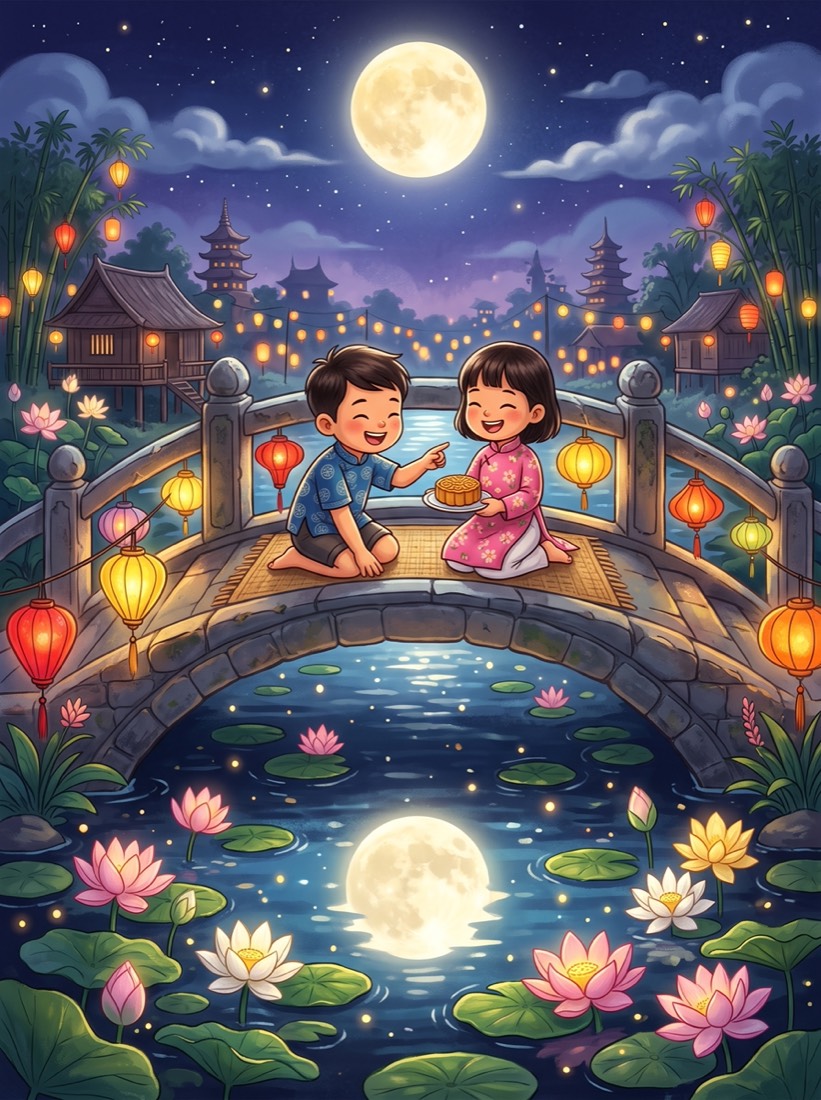
A mooncake is dense, rich and round, usually stamped on top with a character or a pattern, and often holding a salted egg yolk at its centre to stand for the full moon. They are not cut into halves. They are cut into small wedges so that everyone at the table — including the people who arrived late, and the neighbour who dropped in — gets a piece. The sharing is the point of the object.
The same moon, across the region
Mid-Autumn is marked well beyond China and Vietnam. Malaysian and Singaporean communities hold lantern walks, night markets and mooncake gifting; in Cambodia the moon is honoured at Sampeah Preah Khe, with flattened rice — Ok Ambok — eaten under it, alongside the river festival of Bon Om Touk.
Neighbouring cultures keep their own full-moon and lantern festivals that are often mentioned in the same breath but are genuinely separate occasions on separate dates — Thailand’s Loy Krathong, with its floating candles, and Myanmar’s Thadingyut Festival of Lights among them. They are worth knowing for themselves rather than folded into Mid-Autumn.
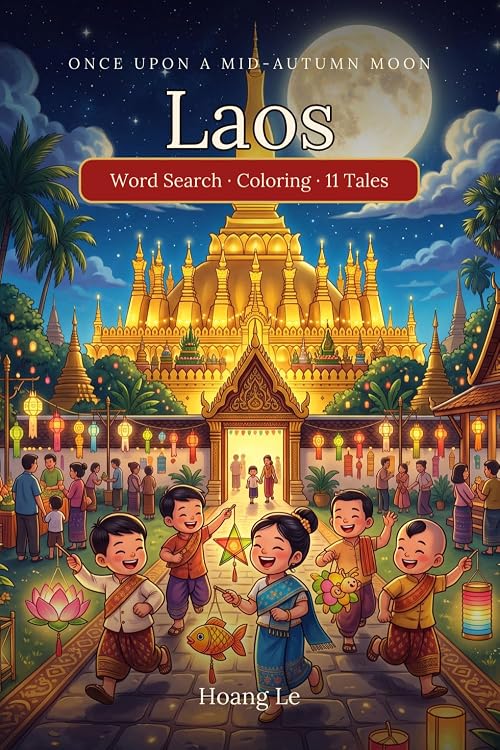
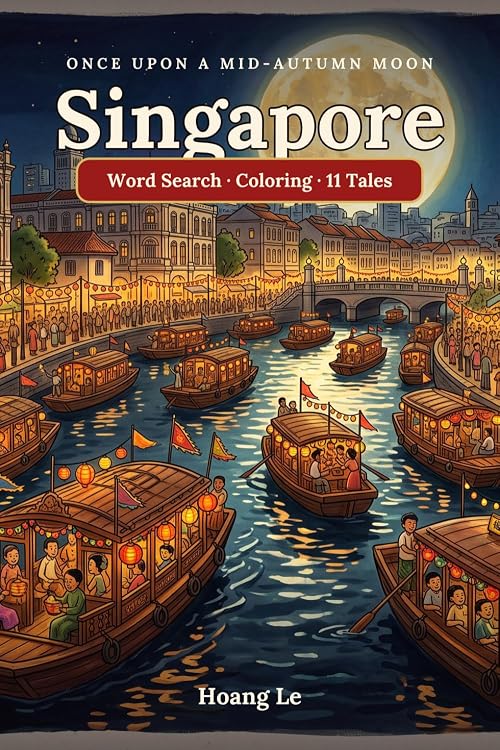
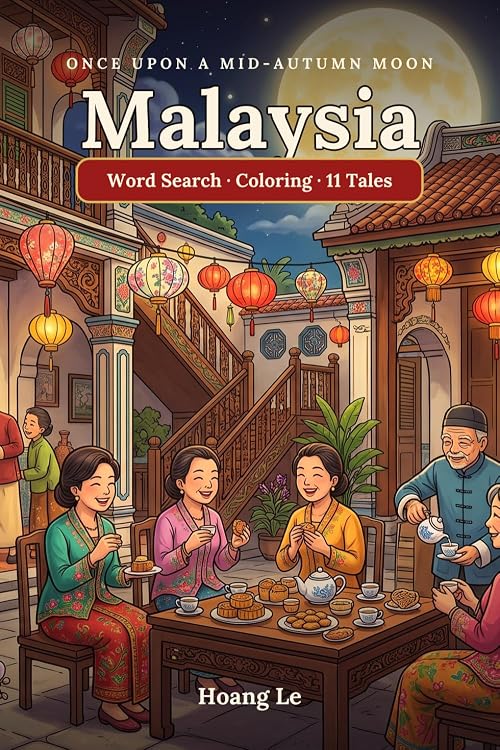
That spread is why every country has a book of its own: Vietnam, China, Myanmar, Thailand, Cambodia, Laos, Singapore and Malaysia each get eleven of their own bedtime tales, with a word search and a full-page coloring picture after every story. A family that keeps one night of the festival reads one book; a classroom walking through the region reads several. And for a family that wants the whole journey at once, the Mid-Autumn treasury gathers all eight lands into one book — 88 bedtime tales, each with its own illustrated plate.
What to do on Moon Festival night
You do not need much, and nothing here needs ordering in advance. Pick two or three — a festival a child remembers is a short one done properly, not a long one got through.
Make a star lantern (đèn ông sao)
You need: ten bamboo skewers or paper straws, string or twist ties, coloured tissue paper, glue, a stick, and a battery tea light.
- Build two flat five-pointed stars, tying the sticks where they cross.
- Join the two stars point to point with five short spacers, so there is a hollow middle.
- Glue tissue paper over the faces, tie the lantern to the stick, and drop the tea light inside. Battery, not a candle — the whole point is that a child gets to carry it.
Write a lantern riddle
You need: a strip of paper, a pen, tape, and something very small as a prize.
- Write a riddle on the strip and tape it to the outside of a lantern.
- Everyone gets one guess each time they pass it. This is the old Chinese lantern-riddle game and it works exactly as well in a kitchen.
- Let the child who solves it write the next one. That is usually where the evening actually starts.
Share something round
You need: a mooncake if you can find one, a pomelo or any round fruit if you cannot.
- Cut it into small wedges — smaller than feels right.
- Make sure everybody at the table gets a piece, including whoever turned up late.
- Name one person who is not there and set a piece aside for them. That is the part of the night that is actually about something.
Go outside and find the shadow on the moon
You need: a coat. Binoculars if you own a pair, but they are not necessary.
- Look up your local moonrise time in the afternoon so you are not waiting around in the dark.
- Go out, look up, and ask what they can see in the shadows — before telling them what they are supposed to see.
- Then tell them: a man under a tree, or a lady and her rabbit, depending on which story you told. Children who found it themselves first never forget it.
Watch a lion dance
You need: a local Vietnamese or Chinese community centre, temple or grocery district — or a screen, which is a perfectly good substitute.
- Check listings in the week before the festival; múa lân troupes usually perform on the nearest weekend rather than the night itself.
- If you are watching at home, hand your child a wooden spoon and an upturned pot. The drum is half of it, and small children take the job extremely seriously.
Bake or buy a mooncake
You need: an Asian grocery in the two weeks before the festival, when the boxes appear near the front of the shop.
- Buy one small box rather than a large one. They are rich, and a little goes a long way with children.
- Traditional lotus-seed-and-salted-egg-yolk is an acquired taste; red-bean or a fruit filling is the safer first mooncake.
- If nothing is nearby, a round cake or a plain shortbread pressed with a stamp does the job. It is round and it is shared, which is the whole requirement.
If you only do three things
Everything above is optional. These three are the ones that carry the night on their own:
- Make a lantern and walk with it. Paper, a stick and a small light is enough. The walk after dark is the part children remember.
- Share something round. A mooncake if you can find one, a pomelo or any round fruit if you cannot. Cut it small and pass it around.
- Tell one story about the moon. Chú Cuội under his banyan tree, or Chang’e and her rabbit. One story, told properly, does more than a dozen facts.