A shortcut shows up constantly in children's media set anywhere east of Istanbul: a vague, composite "Asia," built from whichever lanterns, dragons, and gongs the illustrator had on hand, with no particular country actually meant. It reads as respectful enough on the surface. It is not. Folding a dozen distinct countries, languages, and histories into one interchangeable backdrop is its own quiet way of saying none of them mattered enough to look up.
The test a book like this has to pass
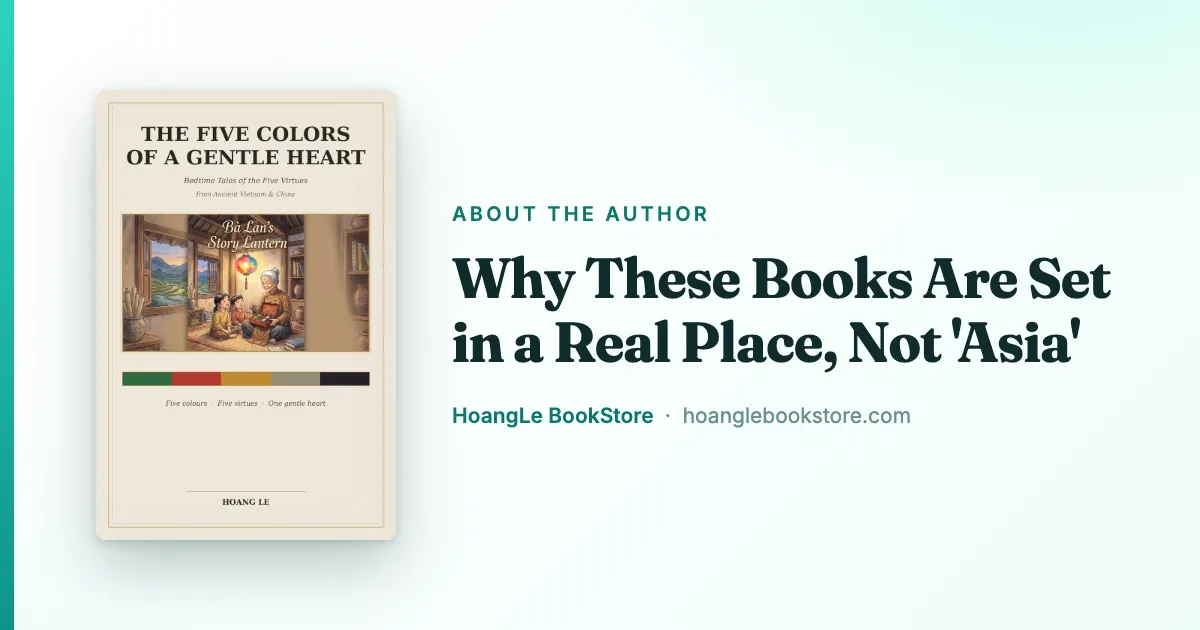
Once Upon a Lantern, the series that includes The Five Colors of a Gentle Heart and the ongoing Once Upon a Mid-Autumn Moon collection, was built to fail that shortcut on purpose. Every story is set in a named country, built from that country's own customs, told with that country's own words. Vietnam's Tết Trung Thu is not China's Zhōngqiū Jié, even though both fall on the same full-moon night and both got folded, for a while, into that same lazy "Asia" backdrop by books that never bothered to ask which one they meant. Myanmar's Thadingyut is not Thailand's Wâi Phrá Jan. Cambodia's Bon Om Touk is not Laos's Lai Heua Fai. Each has its own name, its own central custom, its own real vocabulary, and treating them as interchangeable would flatten exactly the detail that makes any one of them worth telling in the first place.
Why the distinction matters more for children's books than almost anywhere else
A child meeting a culture for the first time through a story does not yet have the context to correct a lazy generalization. If the only Asian setting they ever see in a book is a vague composite, that vagueness becomes their whole mental picture of an entire, staggeringly varied part of the world — a picture that will need to be unlearned later, the hard way, by a teacher or a friend or a trip that shows them how much the book left out. Get it specific and named from the start, and there is nothing to unlearn. A child who grows up knowing that Cambodia's moon festival centers on a boat race down the Tonle Sap, and that Laos's centers on a river of floating fire-boats down the Mekong, has learned something true and small and real, rather than something vague and borrowed.
What "real" actually requires
This is also, quietly, why research has to come before writing rather than after it. A story about Thadingyut has to know that its central custom is kadaw, a bow of thanks and forgiveness performed to parents and teachers, not invented for the plot. A story about Bon Om Touk has to know its climax is a midnight wish made to the moon called Sampeah Preah Khe, not a generic "make a wish" moment borrowed from somewhere else entirely. Getting these details right is not decoration. It is the whole reason a specific country's chapter reads differently from its neighbor's, instead of being the same story with the lanterns recolored.
None of this is presented to a young reader as a lesson in cultural literacy, which would defeat the point entirely — a five-year-old does not need to be told that specificity matters. They simply need to be given it, story after story, country after country, until a rich and varied world becomes the ordinary shape of what a bedtime story looks like, rather than the exception to a vague, borrowed default.
The multicultural children's books page has more on how this runs through the whole catalog, and the Once Upon a Lantern series — including The Five Colors of a Gentle Heart and the growing eight-country Mid-Autumn Moon collection — is on the series hub now, one named country at a time.