"New adult" shows up on more romance shelves every year, and it is one of the few genre labels that confuses readers more the second time they notice it than the first. It sounds like it should mean "adult, but newer," which tells you nothing useful. It actually names something specific, and knowing what it names changes which books you reach for.
A category for the years right after "young adult"
New adult romance is generally written about characters in their late teens to mid-twenties: old enough to have left the structure of home or school behind, too new to adult life to have settled into it yet. The category took shape in publishing as a way to describe exactly that gap, stories with the emotional intensity readers loved in young adult fiction, but about characters navigating a first apartment, a first real job, or a first serious relationship, rather than a first day of high school.
How it differs from YA and from adult contemporary
Young adult romance is usually about characters still inside school and still living under someone else's roof, with the stakes scaled to that world: a first crush unfolding between classes, a secret kept from a parent down the hall. Adult contemporary romance usually assumes a character who has already built a life, a career, a home, a history of past relationships, and the story turns on what happens inside that life, often a second chance or a relationship tested by everything built up around it. New adult sits in the narrow space between the two: enough independence to make real decisions alone, not enough history yet to have settled who they are. That combination is a lot of why first love hits so hard in these stories. There is no earlier relationship on record to compare it to, and no parent down the hall to soften the landing if it goes wrong. On a shopping page, the clearest signal is usually the category breadcrumb rather than the cover art: "Romance > New Adult & College" reads very differently from "Romance > Contemporary," even when the covers look similar.
Why it fits a story like Of Sea and River
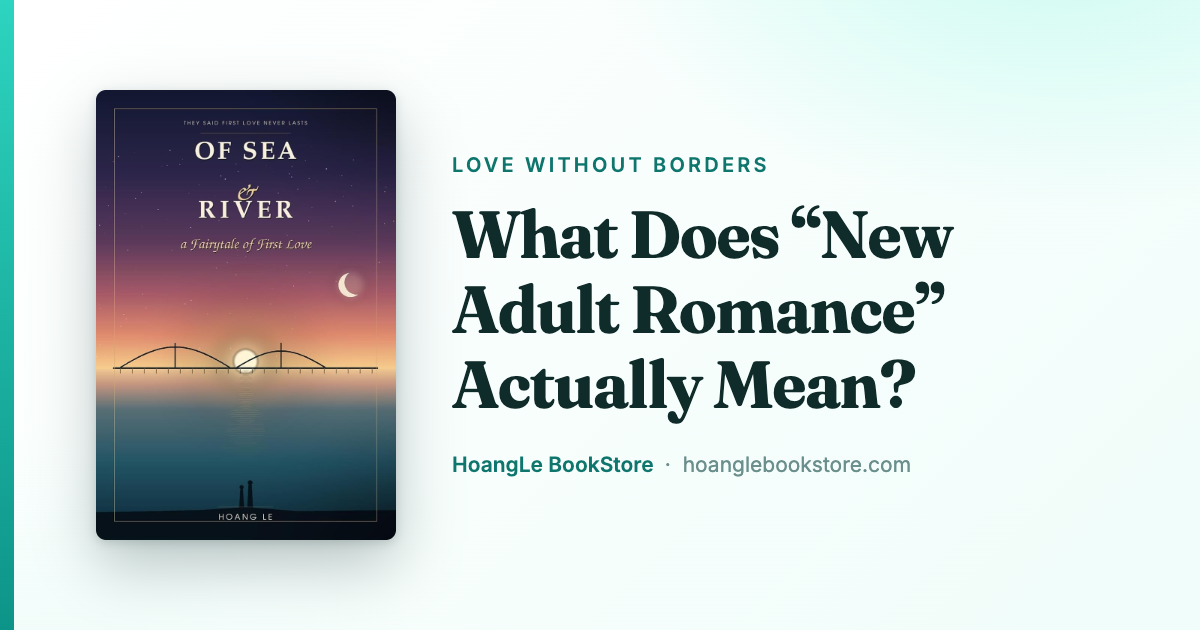
Of Sea and River is shelved as new adult for a reason that shows up on the page. Hoàng and Mai are two young people early enough into their adult lives that this is their first real love, not their latest one. He belongs to the sea, she belongs to a city of rivers, and an accidental spilled coffee is what starts six hundred kilometers of good-morning messages and a sunset passed between them each evening. When a once-in-a-lifetime opportunity threatens to put an ocean between them instead of a country, the choice they face is the kind only available to people still deciding who they are going to become, which is exactly the territory new adult romance is built to hold. Of Sea and River is one of five novels in the Love Without Borders series, each built around two people kept apart by a real border of distance, culture, or history.
What to look for if you want more of this category
If a "new adult" label caught your eye, look for three things on the back cover. Characters who are clearly out of their teens but not yet settled into an established career or home. A first-love or first-serious-relationship premise rather than a reunion or a divorce in the backstory. And stakes that come from one big, early decision, where to live, which job to take, whether to follow someone across a distance, rather than from an already-established life being disrupted. Those three sort a new adult shelf from an adult contemporary one faster than the label by itself ever will, and they are worth checking before you buy if what you actually want is the specific ache of a first love rather than a reunion.