








To play Thanksgiving bingo with kids, give each player a card of pictures, pull one picture at a time from a bag and show it, and let everyone cover a matching square. The first player to cover a full row calls out "Bingo!". For ages 3 to 8, use pictures instead of numbers, keep each round short, and play several rounds so more than one child wins. You can run it tonight with paper, a pencil and a handful of dried corn.
What you need
Each player needs one card and about a dozen markers. A card is just a grid of pictures, and the caller needs the same pictures on small separate slips, folded or turned face down in a bowl or bag.
For a homemade set, draw a grid with 9 squares (3 by 3) for ages 3 to 5, or 16 squares (4 by 4) for ages 6 to 8. Fill each square with a simple Thanksgiving picture: turkey, pumpkin, corn, pie, leaf, apple, acorn, cranberries, squash, a bread roll, a spoon, a candle. Add the word underneath for children who are starting to read. Make each card a little different by shuffling the pictures. If every card matches, everyone wins on the same call.
Draw each picture again on a slip of paper for the caller's bag. Dried corn kernels, dried beans or small torn pieces of paper all work as markers. Keep dried beans and kernels away from children under 3 and from any child who still puts small things in their mouth.
How to play, step by step
1. Give each child a card and a small pile of markers.
2. Agree on how to win before the first call. Start with one full row, across or down.
3. The caller pulls a slip, holds it up, and says the name out loud: "Pumpkin pie."
4. Everyone looks for that picture. If it is on their card, they cover it.
5. Keep the called slips in a pile so you can check a winner's card against them.
6. When a child has a full row, they say "Bingo!" and you check the card together by reading the covered pictures back.
7. Clear the cards and play again.
Let the children take turns being the caller. It is a good job for a 7 or 8-year-old.
More ways to win
One row gets old quickly, so change the goal each round. Four corners means covering the top two and bottom two squares. A full card, often called blackout, means covering every square, which makes a longer and calmer round. An X means covering both diagonals. A picture frame means covering every square around the edge. Changing the goal gives different children a chance to be first.
Ages 3 to 8 at the same table
Mixed ages are normal at a family Thanksgiving, and bingo handles them well because the game is matching, not reading.
Ages 3 to 4: use the 3 by 3 card, a short list of pictures, and one winning line. Sit next to them and point as you call.
Ages 5 to 6: use the same card or a 4 by 4 card. Ask them to say the name of the picture before they cover it.
Ages 7 to 8: let them call, check winners, or play a harder goal such as four corners or a full card.
Sitting time matters. Naître et grandir, a Québec parenting site (page updated March 2022), says children can generally sit for 2 to 5 minutes per year of age, so a 3-year-old may manage about 6 to 15 minutes and a 5-year-old about 10 to 25. Plan rounds of five or six minutes and stop while they still want one more.
Keeping it calm and fair
Most bingo arguments come from two things: someone is sure they were first, and someone did not win. A few rules, said before the game, take care of both.
Say the rules out loud once: "We play until someone calls bingo. If two people call at the same time, you both win." Use a "tie means both win" rule every time. Give the winner a small job, such as choosing the next goal, rather than a prize that someone else will want. Praise how the children play, with comments like "You waited for your turn" or "You noticed that your cousin had that picture too."
If a child melts down when they do not win, pause the game and name the feeling in one short sentence: "You wanted to be first." Then offer a way back in, such as calling the next round. If a child is too upset to play, let them step away and rejoin when they are ready.
A thank-you twist
Add gratitude to the game without turning it into a lesson. When a child covers a square, they name something they are thankful for. It can be small, like the pie or the dog under the table. The American Academy of Pediatrics (HealthyChildren.org) suggests talking about even one small thing a family is grateful for, and says not to save gratitude conversations for Thanksgiving alone. A game is an easy place to practice it. For the Thanksgiving table itself, see our post on Thanksgiving kids' table games for a calmer dinner, and for a similar format with a different holiday, how to run a Halloween bingo party.
Why a simple game is worth the time
The American Academy of Pediatrics clinical report on play (2018) says that play with parents and peers supports children's social-emotional, language, cognitive and self-regulation skills. Bingo uses several of those at once: waiting for a turn, taking in a call, matching, and handling a win or a loss. Research on number board games (Ramani and Siegler, 2008) found that four 15-minute sessions improved low-income preschoolers' number estimation, while a version that used colors in place of numbers did not. That study was about numbers, not picture bingo, so read it as a hint that short, repeated games can add up, not as a promise about what bingo will teach.
If you want a ready-made set
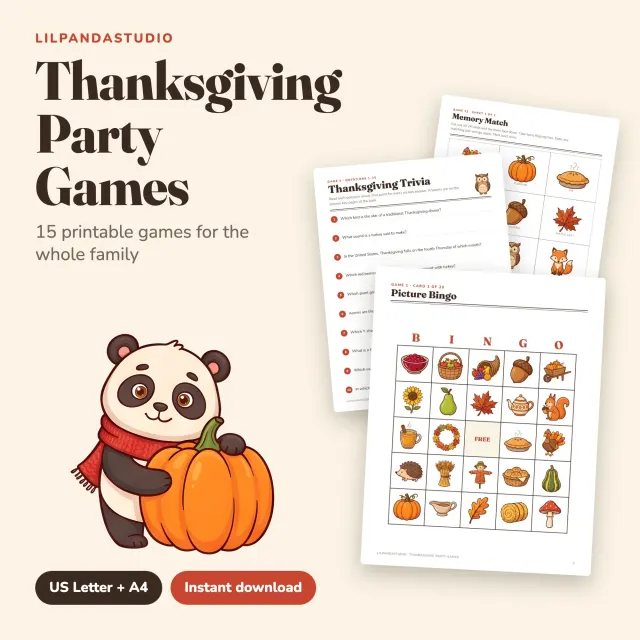
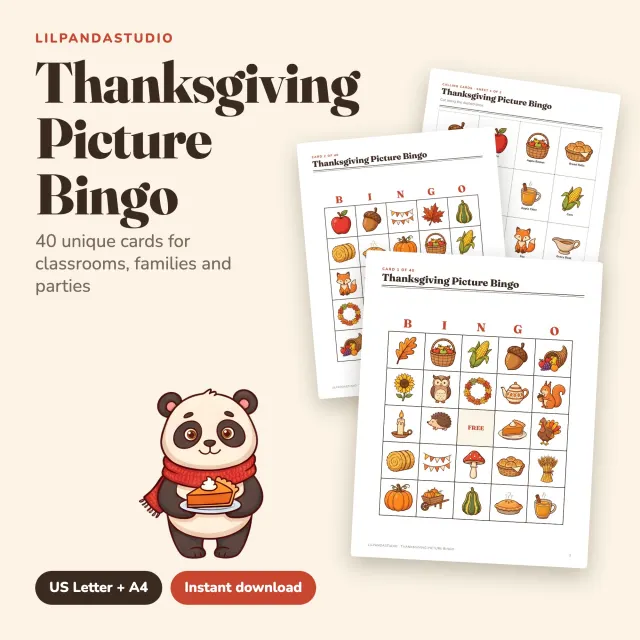
Thanksgiving Picture Bingo is a printable version of this game. It has 40 unique picture bingo cards, 32 picture calling cards with names, cut-out markers, and a how-to-play page with extra ways to win. No reading is needed. It comes in US Letter and A4, in color and ink-saving black and gray editions, as a digital download for personal, family and single-classroom use. It is made by LilPandaStudio, the author's own studio, and sold in this shop.
When to ask for help
If a child regularly struggles to take turns, to follow simple rules or to cope with losing, well beyond what other children their age manage, mention it to your pediatrician or your child's teacher.