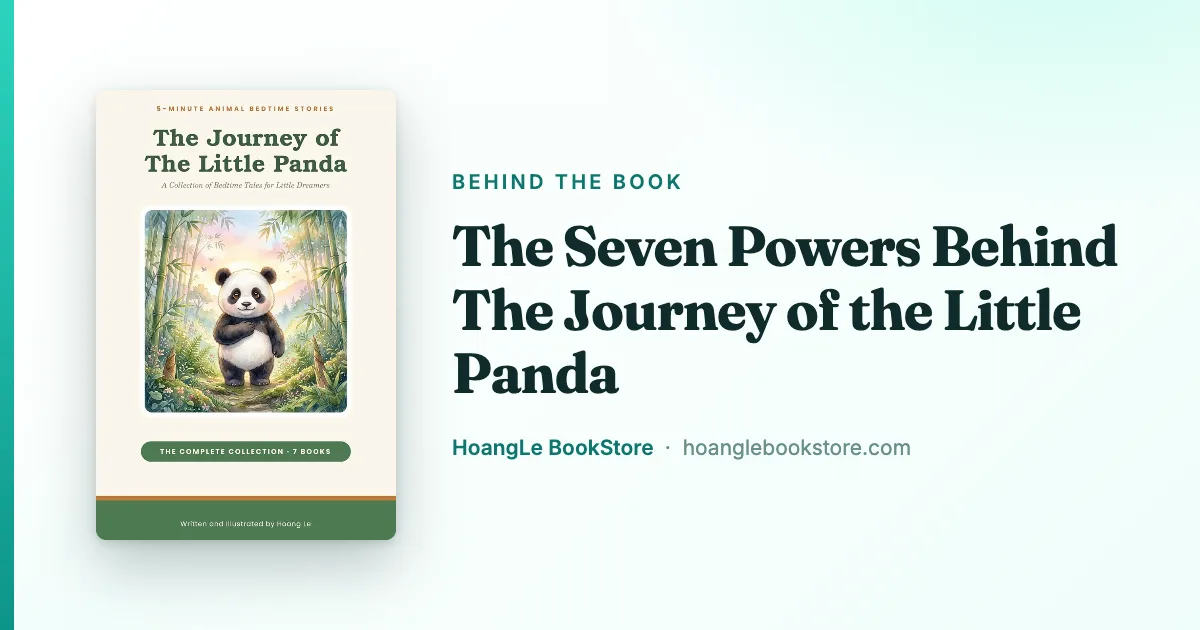
The Journey of the Little Panda began with a simple question: how do you teach a young child what a good life is actually built from, without ever once saying the word "lesson"? The answer Hoang Le landed on was to give a small panda, in the bamboo forests of ancient China, exactly one power to discover per story, and to let each power arrive through something the panda actually has to do, not something he is told.
The seven powers run in a deliberate order, each one setting up the next. The first is Action, and it opens the whole series for a reason: a good idea, on its own, does nothing. In the story that introduces it, Little Panda draws a brilliant plan for a village well during a drought, then waits for the water to appear on the paper. It does not, of course, until his mentor, the God Panda of Mount Jade, tells him plainly that a drawing of a peach never filled a hungry stomach. Little Panda picks up a shovel instead. It is a small moment, but it sets the tone for everything that follows: every power in this series has to be lived, not just understood.
From there the series moves through Kindness, Courtesy, Righteousness, Humanity, Wisdom, and finally Sincerity, and the choice to end there is not an accident. Sincerity, an honest heart, is positioned as the power that holds all the others together, since kindness without honesty curdles into performance, and courage without honesty becomes recklessness. Along the way, Little Panda is never alone in learning any of it. His friends, Ricky the Raccoon, Bella the Bunny, and Old Mr. Goat, each get their own moments of struggling with the same lessons in their own ways, which keeps the series from ever feeling like one perfect character showing everyone else how it is done. Little Panda gets things wrong plenty of times himself, and often needs a friend, not a lecture, to help him see it.
The God Panda of Mount Jade functions as the series' quiet moral center without ever becoming preachy, largely because he almost never simply tells Little Panda the answer. He asks a question, offers an image, and lets the small panda work the rest out through action, which mirrors the exact lesson the first story is built around: understanding is not the same as doing.
What has made the series resonate with families is partly its structure. Each of the seven stories is short enough for a single bedtime, self-contained enough to be read in any order, and built around one clear virtue rather than a tangle of several at once, so a parent can choose deliberately: a night for courage, a night for honesty, a night for compassion for other creatures. That structure has since carried over into newer entries in the world, including a recent addition that takes the same framework of visible virtues and applies it to a season every family recognizes: the nervous, hopeful first days of a new school year.
It also helps that none of the seven virtues are presented as more important than the others, which is a deliberate choice worth noticing. A lot of children's media quietly treats courage or kindness as the "main" virtue and everything else as supporting material. This series treats all seven as equally load-bearing, on the theory that a person who is only kind, without also being honest, wise, and willing to act, is not actually the fully formed character the series is trying to describe. Watching the same small panda need all seven qualities, at different times, to get through an ordinary problem is part of what makes the series feel less like a checklist of good behavior and more like an honest picture of what growing up asks of a person.
The full seven-book collection, along with the newer additions to the Little Panda world, is available now on the books page.