Ask what Cambodia's Mid-Autumn season looks like and the honest answer is: nothing like a quiet moon-viewing at all, at least not at first. Bon Om Touk, the Water and Moon Festival, opens with some of the loudest, most exuberant boats on the calendar — long, brightly painted racing boats packed with rowers, cheered on by enormous crowds along the banks of the Tonle Sap. The moon shows up later, at midnight, in a much quieter register entirely.
A festival with two very different halves
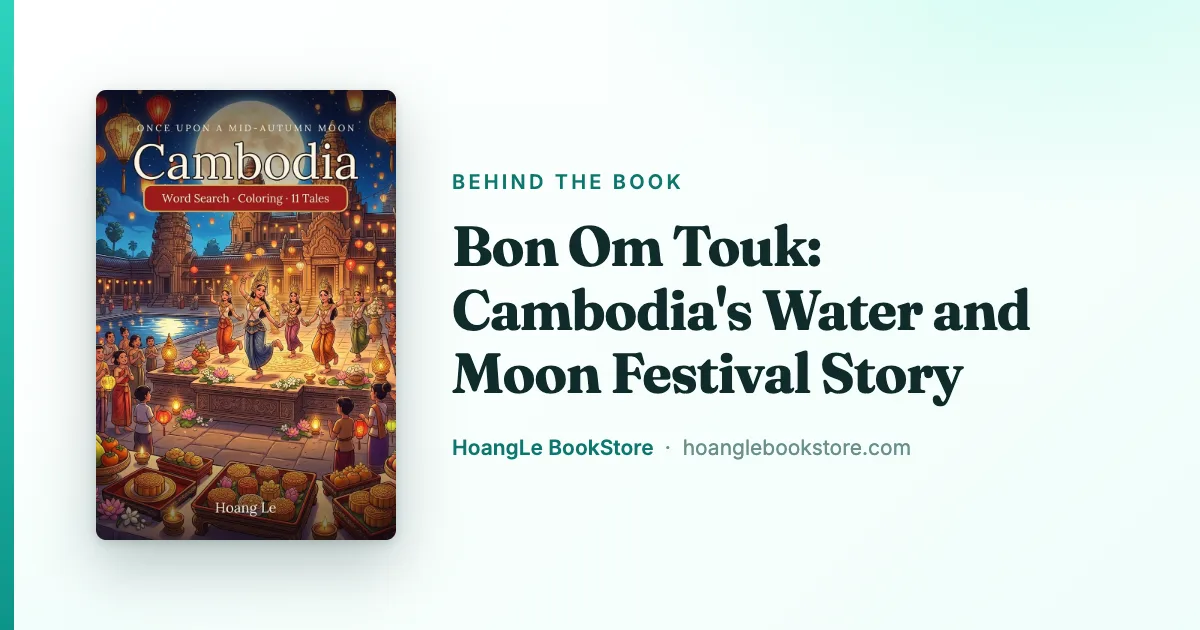
That contrast is the whole shape of Once Upon a Mid-Autumn Moon in Cambodia. The first half of the book lives in the noise: a boat race lost by inches, a lion dance so loud and wild it frightens a small boy half to death, a fruit-seller's basket spilled and scattered through a crowded market. The second half turns quiet, moving toward Sampeah Preah Khe, the Salutation to the Moon — a midnight ceremony where families kneel before offerings of ambok, sweet flattened rice mixed with banana and coconut, and elders press a pinch of it into each child's mouth as they make a single, private wish to the moon.
Real customs, told through small choices
Each of the eleven stories takes one piece of that real festival and builds a child's ordinary choice around it. A boy who comes in second in the boat race chooses to cheer for the winning crew instead of sulking, and finds that a good heart is its own kind of prize. A girl teaches her frightened younger cousin that the moon's own reflection is floating right there on the dark water beside them, so the dark never has to feel quite so lonely. A boy finds a lost sandal in a packed festival crowd and spends the evening tracking down its owner instead of pocketing it, because a thing that isn't yours can never actually make you glad.
The spotlight story, the eleventh, is the gentlest of the set. A boy named Panha is handed the traditional pinch of ambok and told to close his eyes and make a wish — and, watching his grandmother's tired hands as she prepares the offering, he lets go of the toy he had been dreaming of all month and wishes for her health instead. It is Bon Om Touk's central custom, rendered as a specific, ordinary act of a child noticing someone he loves before he notices what he wants.
A few of the quieter stories round out the collection between those two poles. A young dancer learning the slow, deliberate apsara style — the classical dance carved into the stone walls of Angkor itself — discovers that some beautiful things simply cannot be rushed, no matter how impatient she feels. Three children dividing a single coconut for the family's offering learn that fairness means the smallest hands go first, not the strongest ones. Neither story involves a boat or a crowd, and both belong in the book precisely because Bon Om Touk, like most real festivals, is made as much of small domestic moments as it is of its one big spectacle.
A festival that resists the easy version
It would have been simpler to write about only the boat race, which is the part of Bon Om Touk that photographs well and travels easily online. The book resists that shortcut on purpose, because the quieter half — the midnight bow, the shared coconut, the fireflies over a rice field that vanish if the water isn't kept clean — is where most of the festival's real meaning actually sits. Both halves get their own real Khmer vocabulary throughout: tŭk for a boat, chhma for a temple cat, arkoun for thank you.
Cambodia is the fifth country now live in the Once Upon a Mid-Autumn Moon series, joining Vietnam, China, Myanmar, and Thailand, with Laos, Singapore, and Malaysia still to come. Once Upon a Mid-Autumn Moon in Cambodia is available now on the Once Upon a Lantern hub.