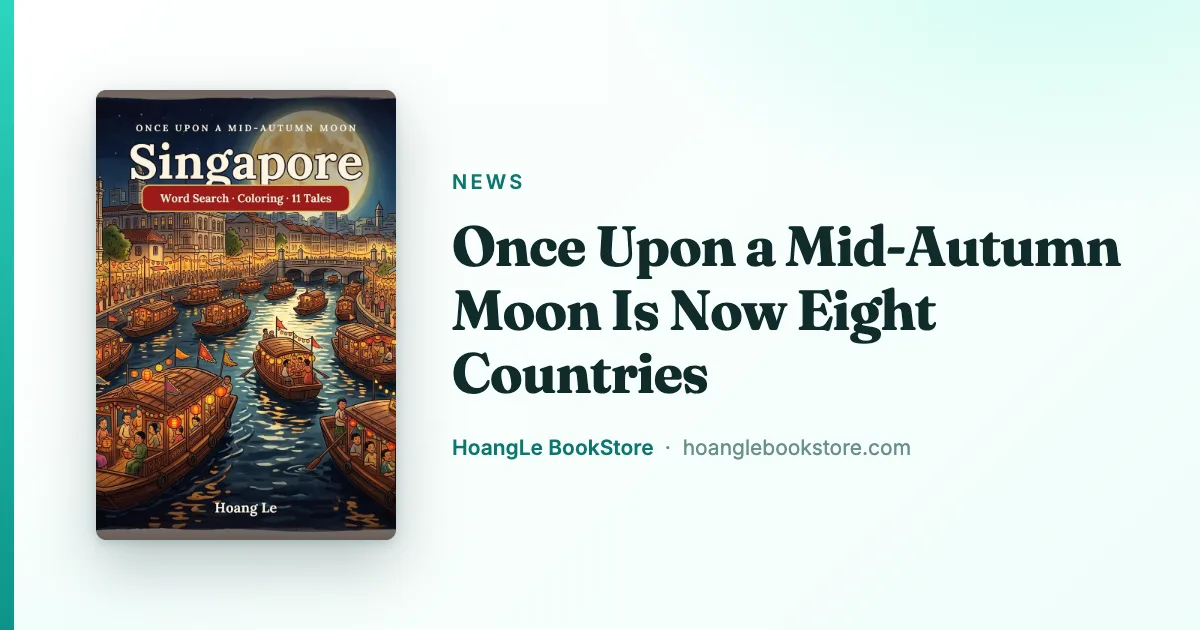
A year ago, Once Upon a Mid-Autumn Moon was a single idea: tell the story of the Mid-Autumn Festival the way a grandmother would, one short bedtime tale at a time. It is now eight books, one for each country, and with Singapore and Malaysia's editions now live alongside Vietnam, China, Myanmar, Thailand, Cambodia, and Laos, the full collection is complete.
Same moon, eight very different festivals
The whole premise of the series rests on a fact that is easy to say and genuinely striking once you sit with it: the same full moon, on the same night in late September, is marked by an enormous, geographically connected stretch of countries, and almost none of them celebrate it the same way. Vietnam's Tết Trung Thu belongs to children, built around star lanterns and lion dances. Cambodia's Bon Om Touk opens with a thundering long-boat race down the Tonle Sap before turning, at midnight, into a quiet wish made to the moon. Laos floats a river's worth of candlelit fire-boats down the Mekong. Myanmar lights a thousand small lamps for Thadingyut and closes with kadaw, a bow of thanks and forgiveness to parents and elders. Thailand keeps two separate festivals in the same season, one of moon-greeting and one of floating river lights. Singapore and Malaysia, both shaped by generations of Chinese immigration alongside Malay and other neighboring traditions, celebrate the festival as multicultural port cities — mooncakes and lantern-lit gardens sitting alongside neighbors who mark the same night quite differently, or not at all.
What the eight-country structure is actually for
Each book stands entirely on its own — eleven bedtime tales built around one country's real customs, closing with a spotlight story built around that country's central ritual, and a glossary of real words in the local language, spoken phonetically. A family can read just the one edition that matches their own heritage, or work through all eight over the course of a season, the way the series frame itself imagines it: a grandparent lighting a new lantern each night as the moon "travels on" from one land to the next.
Building the collection this way, rather than as one book gesturing vaguely at "Asian traditions," was the whole point from the start. A shortcut version of this idea exists in plenty of children's media already — one generic moon festival, one generic lantern, no particular country actually meant. Eight books, eight names, eight sets of real customs and real vocabulary, was the harder and slower way to do it, and it was the only way that actually respects the countries it is telling.
Getting here took longer than a single publishing season. Each country's edition required its own research into customs that do not show up in a casual search — the specific ceremony, the specific vocabulary, the specific balance between a festival's loud public half and its quiet private one — before a single story could be drafted. That slower pace is part of why the collection reads the way it does: eight distinct festivals, not one lantern motif recolored eight times.
Where to start
There is no required order. Families with a personal connection to one of the eight countries often start there; families with none simply start with whichever cover catches a child's eye. All eight are built for ages four to ten, illustrated throughout, with a matching word search and coloring page after every story in the paperback activity editions — which makes them a natural gift as the real festival approaches on Friday, September 25.
The full eight-country collection — Vietnam, China, Myanmar, Thailand, Cambodia, Laos, Singapore, and Malaysia — is on the Once Upon a Lantern hub now, alongside The Five Colors of a Gentle Heart, the book the whole series grew out of.