Long before it was a children's book, the Mid-Autumn Moon was a promise: that once a year, on the night the moon grows fullest, families would gather, share something sweet, and look up at the same sky no matter how far apart the year had scattered them. Once Upon a Mid-Autumn Moon, Hoang Le's ongoing series of bedtime tales, is built to carry that promise into a bedtime routine, one small legend at a time.
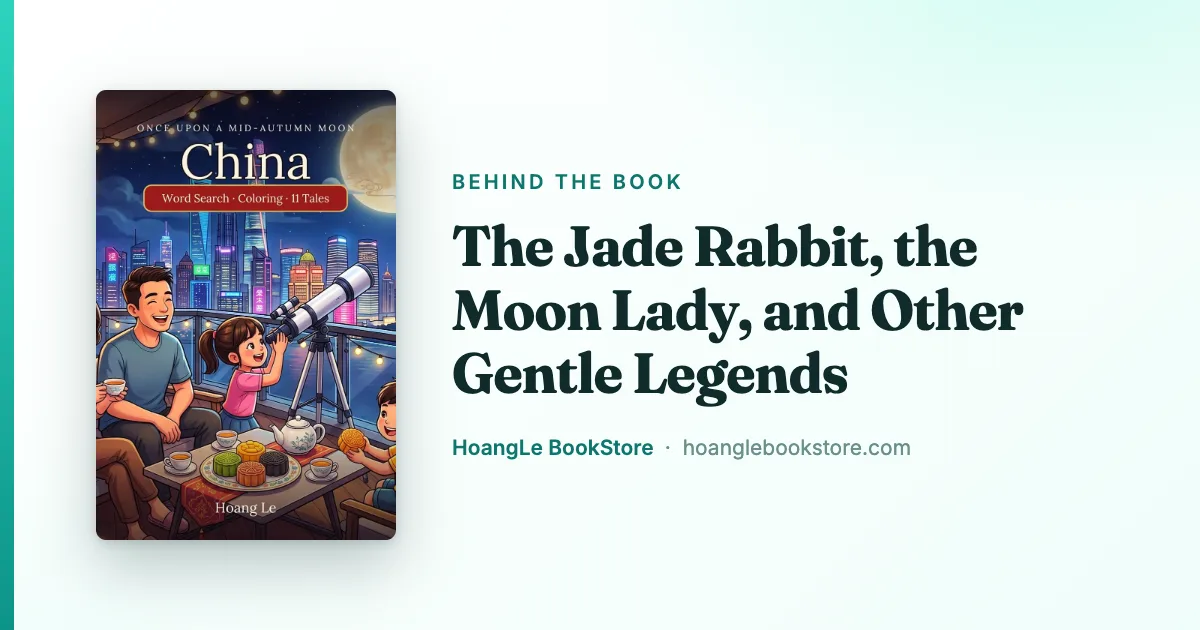
In China, where the festival began, the moon carries its own cast of characters, gentler and stranger than most Western moon lore. There is the Moon Lady, said to live there still, and the jade rabbit who keeps her company, pounding out something sweet under the light of the full moon while children below try to spot its shape in the shadows on the moon's surface. The book's China chapter builds its ten tales and one spotlight story around exactly this cluster of images: mooncakes shared at a family table, the jade rabbit watching quietly from above, and the playful tradition of lantern riddles, where a small poem or puzzle is tucked inside a paper lantern for someone else to solve.
Vietnam keeps its own, distinctly different version of the same night, called Tết Trung Thu, and it belongs to children in a way few other festivals do. The book's Vietnam chapter leans into the star-shaped paper lanterns, đèn ông sao, carried through village streets after dark, the drumming and color of the lion dance, múa lân, performed for exactly this occasion, and the legend of Chú Cuội, a figure said to be stuck on the moon after clinging to a magical banyan tree that lifted him away from the earth. It is a warmer, noisier festival than its Chinese counterpart, built around children being the center of the celebration rather than an afterthought to it, and the book's tone shifts accordingly, a little brighter and a little more playful than the quieter chapters around it.
What ties every chapter of the series together, regardless of which country's moon-night traditions it is telling, is the same frame Hoang has used elsewhere in his work for young readers: a grandmother who lights a lantern each night and tells a child where, exactly, the moon is shining that evening, carrying the story from one land to the next as the year's real moon makes its own way across the sky. It is a small structural choice that does a lot of quiet work. Rather than presenting each country's festival as a separate, disconnected unit, the frame reminds a young reader that all of these different traditions are, in the end, versions of the same simple, universal thing: people who love each other, looking up at the same moon, and telling each other a story about it.
None of these tales are retellings of a single existing legend so much as new stories built from these older motifs, the moon, the rabbit, the lantern, in the spirit of the traditions they come from. It is a gentle way to introduce a child to festivals and folklore that may not be part of their own family's traditions, or to hand a piece of a familiar one back to a child who is only just old enough to start asking where it comes from.
Part of the point of telling both countries' traditions side by side, rather than picking one and treating it as the definitive version, is to be precise about what is shared and what is not. China and Vietnam both celebrate a classic eighth-lunar-month Mid-Autumn festival, and each has developed its own distinct customs around it over centuries of separate history, even as neighboring traditions have influenced each other along the way. Treating them as interchangeable would flatten exactly the kind of cultural detail that makes a folklore collection worth reading in the first place, so each chapter is built and researched as its own tradition rather than a variation on a single template.
The Vietnam and China episodes in the series are available now as ebooks, with more lands still to come, all listed on the books page.