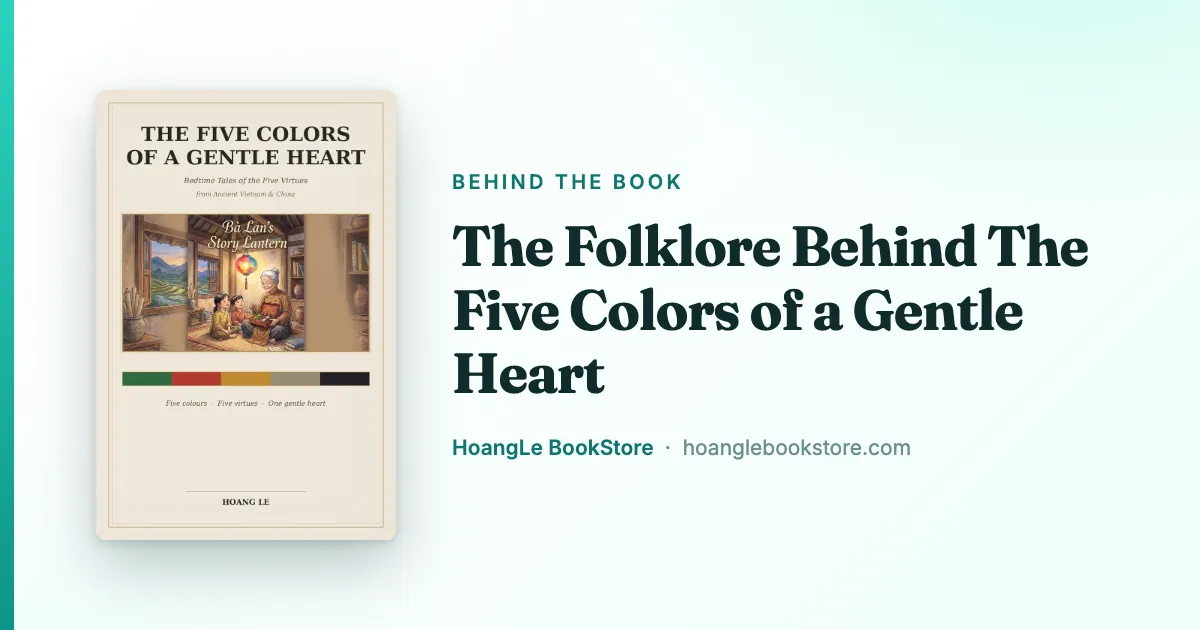
More than two thousand years ago, a set of ideas took hold across East Asia that had nothing to do with religion and everything to do with character: the Five Constants, five qualities said to make a person whole. Kindness. Respect. Trust. Fairness. Wisdom. They were paired, in classical thought, with the Five Elements: wood, fire, earth, metal, and water. The Five Colors of a Gentle Heart is built directly on that old pairing, turning it into a book a family can actually read at bedtime rather than a philosophy a family would have to study.
Each of the twenty stories in the book belongs to one of five chapters, and each chapter carries one virtue, one element, and one traditional color. Green stories, tied to wood, are about kindness. Red stories, tied to fire, are about respect and courtesy. Yellow, tied to earth, is about keeping your word. White, tied to metal, is about fairness. Black, tied to water, is about wisdom. The color is never decoration. It is the organizing idea of the whole chapter, chosen the same way it was chosen twenty-five centuries ago.
What makes the structure work as a children's book, rather than a lesson in disguise, is the frame wrapped around it. A grandmother, Bà Lan, lives at the edge of a village where the mountains meet the rice fields, and lights a different colored lantern as the nights pass. She keeps a small lacquer box holding five colored threads, and each evening her two grandchildren, Mai and her younger brother An, draw one out. Whichever color they pull decides which kind of story she tells that night, and which quiet gift the story leaves behind. It is a gentle piece of narrative engineering: a child does not have to sit through the whole book to get the full experience. Any single thread, on any single night, is a complete evening.
The twenty tales themselves are set across the rice paddies, market towns, mountain passes, and imperial courts of ancient Vietnam and China, and each one is an original story built specifically for this book rather than a retelling of an existing folk tale. A farm girl gives half her last rice seedlings to a starving traveler and her field grows fuller than anyone else's that season. A merchant refuses to use a rigged scale even when honesty costs him money, and his good name outlasts the temptation. A child helps a puzzled magistrate see the truth in a dispute over an orchard. Each story ends with a short, plainly stated lesson and a small glossary explaining any Vietnamese words used in that tale, so the book teaches a little bit of language alongside the virtue.
By the closing pages, all five colored threads are braided into a single cord, and Bà Lan ties it around Mai's and An's wrists before tucking them in. It is the book's one explicit statement of its own thesis: a person is never only one color. They are all five, woven together, and that is precisely what the old teachers meant when they said the world itself is woven from five things.
Reading it as an adult, what stands out is how little the book insists on any of this. A child can enjoy any single story purely as a story, with no awareness that it is standing in a two-thousand-year-old tradition. That is by design. The oldest ideas about character were never meant to be memorized. They were meant to be told, one small story at a time, until they simply became part of how a person sees the world. The Five Colors of a Gentle Heart is on the books page for anyone who wants to start drawing threads of their own.