A specific kind of pressure shows up for a lot of parents raising kids across two cultures or two generations of distance from where a family started: the sense that you are supposed to already be the expert on a heritage you yourself are still, quietly, in the middle of learning. It is worth saying plainly that this is an extremely common position to be in, and it is not a disqualifying one.
You do not have to know everything first
A parent who grew up somewhat disconnected from a grandparent's country, language, or customs often assumes the job is to catch up privately before teaching anything at all — to become fluent, or well-read, or confident, and only then pass it along. That standard is both unrealistic and unnecessary. Kids do not need a parent who already knows everything. They need a parent willing to be curious about it together with them, out loud, including the parts the parent is still figuring out.
Saying "I'm not sure, let's find out" to a child's question about where a tradition comes from is not a failure of authority. It models something more useful than a confident answer would: that a heritage is not a fixed test you either pass or fail, but something you keep coming back to and learning a little more of, for your whole life, and that this is completely normal.
Small, honest starting points
You do not need a grand plan to begin. A single dish cooked the way a grandparent used to make it, imperfectly, is a starting point. A handful of words in a language you are only partly fluent in yourself, said at the right moment, is a starting point. A book that carries a few real words of a heritage language, gently translated, gives a child a small, low-stakes way in — hearing a word said aloud, seeing it explained simply, without either of you needing to already be fluent.
Stories that are set in a real, specific place rather than a vague composite version of "where the family is from" do real work here too, because they hand a child something concrete to hold onto: not a feeling of general connection to a broad region, but one particular festival, one particular custom, one particular word, that a family can actually build on together over time.
It also helps to let a child see you get something wrong and correct it, rather than quietly hoping they never notice a gap in what you know. Mispronouncing a word and then looking it up together, or admitting a family story might have a detail or two blurred by time, teaches something a polished, confident version of heritage never could: that this is a living thing, still being pieced together, rather than a finished exhibit a parent is simply narrating.
What actually sticks
What children remember from this kind of effort is rarely the accuracy of any single fact. It is the repetition, and the warmth attached to it — a story told at the same time every year, a dish made for the same holiday, a grandparent called on the same night a family always calls. The thread that connects a child to a heritage is built less by information than by return: coming back to the same place, the same story, the same small ritual, again and again, until it becomes simply part of how the year moves.
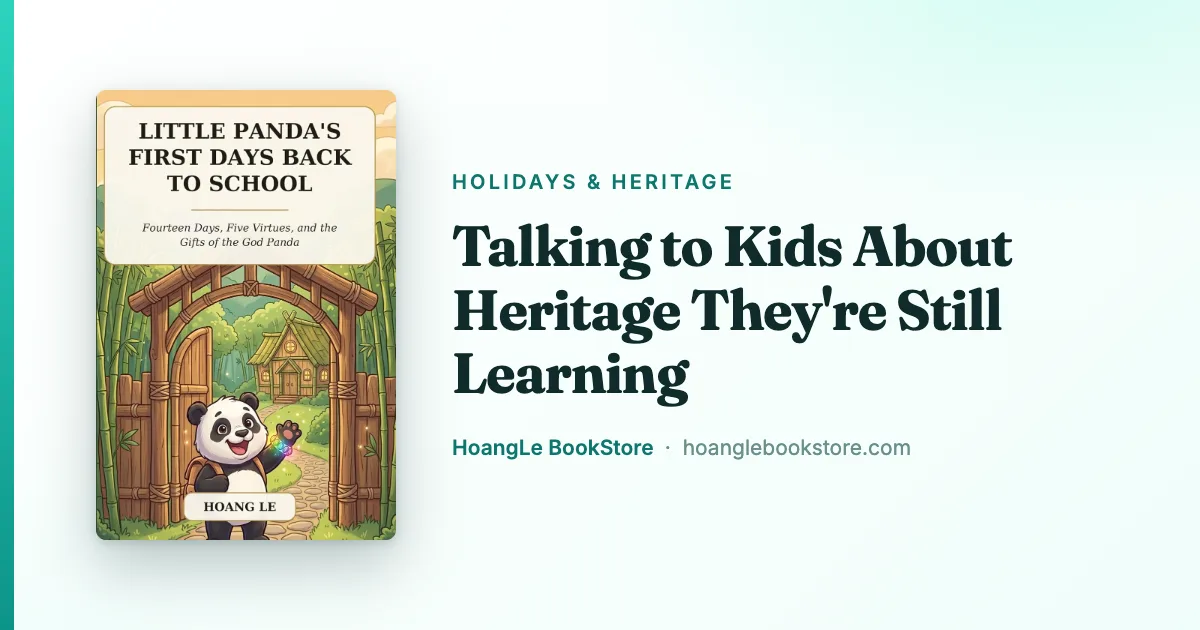
None of this requires perfection, least of all from a parent who is themselves still learning. What it requires is showing up for it, imperfectly and repeatedly, which is a far more achievable standard than expertise — and, as it turns out, the only one that actually works. Little Panda's First Days Back to School and the wider catalog on the books page are built around exactly this kind of small, repeated return to a heritage worth knowing.