Sooner or later, usually around a paper lantern in a store window or a mooncake box at the grocery store, a small kid is going to ask what the Mid-Autumn Festival actually is. It is a fair question, and it deserves a better answer than "it's an Asian holiday," which is true in the way that "Christmas is a Western holiday" is true: accurate, and not remotely the point.
What the festival actually is
Once a year, on the night the moon is at its roundest and fullest, families across a dozen countries stop what they are doing and look up. It falls on the fifteenth day of the eighth month of the lunar calendar, which lands in late September most years — this year, Friday, September 25. Vietnam calls it Tết Trung Thu. China calls it Zhōngqiū Jié. Myanmar calls it Thadingyut. Cambodia calls it Bon Om Touk. Each country has its own name, its own food, its own way of marking the night — but underneath all of it sits the same simple idea: the harvest is in, the moon is full, and this is the night you come home.
A simple way to say it to a young child
You do not need the lunar calendar to explain this to a four-year-old. You need one sentence: "Once a year, the moon grows as big and round as it will get all year long, and every family, everywhere, looks up at that very same moon on the very same night." That single fact, that it is the same moon over every house, is doing more work than any explanation of lunar calendars ever could. It is the whole idea in one image a small child can actually hold onto.
From there, the specifics are easy to layer in, and better shown than explained. A round mooncake, cut into wedges and passed around the table, so that everyone tastes the same sweetness at the same moment. A paper lantern, carried through the dark after dinner, its small light a little stand-in for the big one overhead. A story about a rabbit, or a lady, or a boy who got stuck on the moon, depending on which country's version you are telling. None of it needs to be presented as homework. It works because it is fun first.
Two small rituals that make it land
If you want the idea to actually stick rather than just be heard once and forgotten, give it a body. Cut something round in half and pass the pieces around the table before anyone eats — a piece of fruit works as well as a mooncake, and the passing is the part that matters, not the specific food. Then, after dark, take a short walk with a lantern or even a flashlight, and spend two minutes actually looking at the moon together: pointing out the shadows, guessing what shape they make, asking what the same moon might be shining on right now, on someone else you love who is far away.
That second piece is quietly the whole reason the holiday has lasted this long. Long before video calls, a shared full moon was the only thing a family scattered across a war, a harvest, or an ocean could still reliably share on the same night. A grandparent in one country and a grandchild in another could still, in a real sense, look up together. That is worth handing a child before it is worth handing them a mooncake.
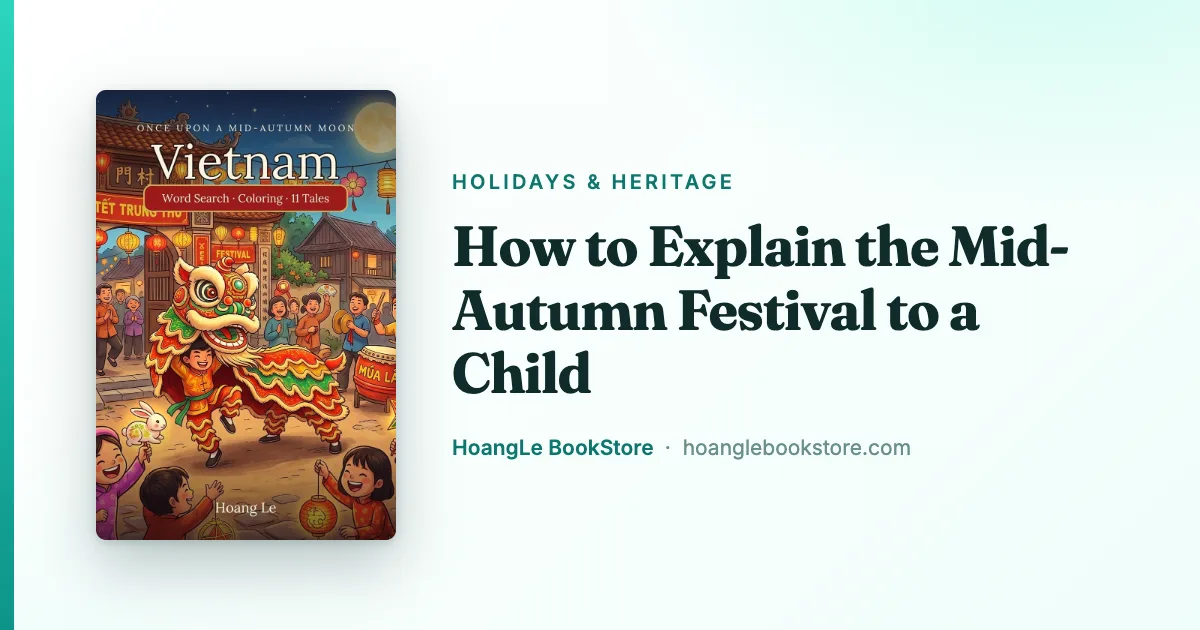
For families who want to go a night at a time rather than all at once, Once Upon a Mid-Autumn Moon in Vietnam tells the festival the way a grandmother would: one short bedtime story a night, each one built around a real custom — a star lantern, a lion dance, a boy on the moon — rather than one long lecture about a calendar. For the fuller picture of how the festival is marked across every country in the series, the Mid-Autumn Festival page has the whole rundown in one place.
None of this needs to be perfect on the first try. A four-year-old does not need the full history of the lunar calendar tonight. They need one moon, one story, and the simple, sturdy idea that somewhere, right now, someone else who loves them is looking up at the exact same sky.