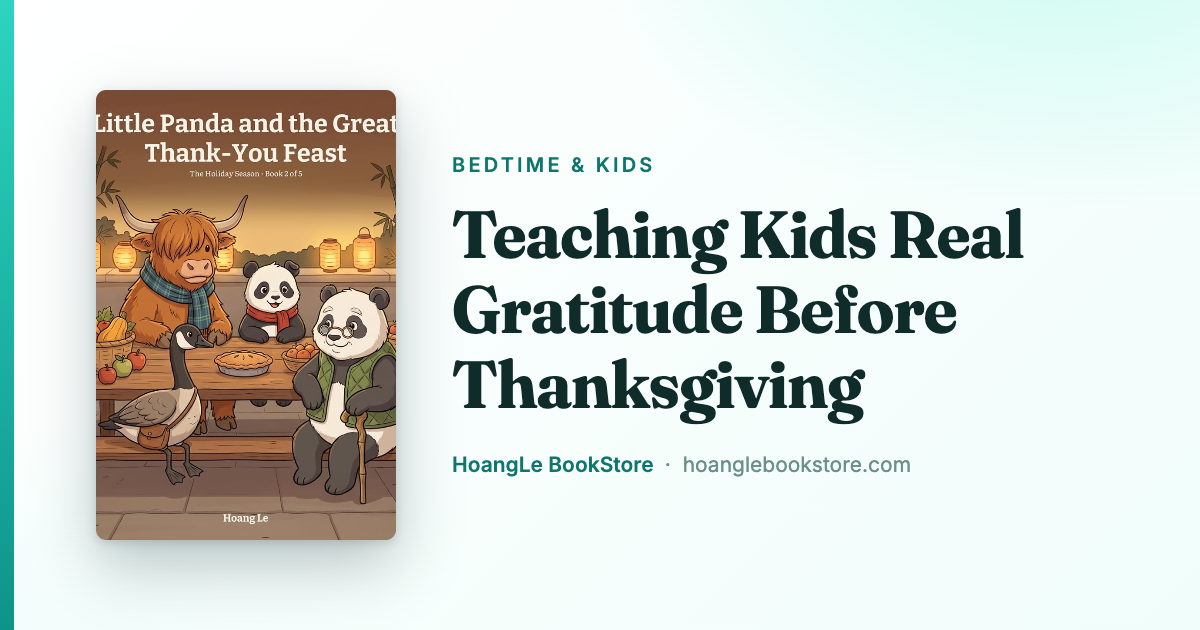
Ask a four-year-old to "be thankful" and you will usually get a shrug, or a recited answer that does not mean much to them yet. Gratitude is not an instruction you can hand a young child. It is a habit you build with small, repeated practice, and fall is a natural season to start one.
Why "say thank you" is not the same as gratitude
Manners and gratitude look similar from the outside and are not the same thing. A child can say "thank you" on cue without feeling anything behind it, and a child can feel genuinely glad about something and never think to say the word at all. What actually builds the habit is naming, out loud and often, one specific thing you are glad of, not a general "everything," but one real thing, said in front of people who do the same. Repetition is what turns it into a reflex instead of a performance. Somewhere between four and eight, most children can hold onto a concept like "thankful" only once it is tied to something concrete they can point to, rather than an abstract feeling they are told to perform on command. A tired bird landing in your yard is concrete. "Be grateful" on its own is not.
A small ritual borrowed from a goose who flew the wrong distance
Little Panda and the Great Thank-You Feast gives this idea a shape a young child can actually picture. The story opens with a tired Canada goose named Maple landing in the valley mid-migration, and the valley looking after her, which is what sends Little Panda down a real question: why do two countries keep the same feast two months apart? Following it takes him through the Wampanoag Nation's own part of the story, a letter-writer named Sarah Josepha Hale who wrote for seventeen years before anyone listened, and a president who finally said yes. The book does not rush past the harder parts of that history to get to the feast; it treats them honestly and gently, at a young reader's pace, rather than tidying them away. It ends with Little Panda running his own thank-you circle, where everyone at the table names one thing they are glad of, including a friend whose honest answer is that he is homesick, which is as real a feeling as gratitude ever gets.
Try a thank-you circle at your own table
You do not need a feast to run a version of this. Before a meal, or at bedtime, go around and have each person name exactly one thing, out loud, no repeats once something has been said. It works at breakfast just as well as it works at the big table in November; the only rule that actually matters is that it happens again the next day. Let a less cheerful answer stand without correcting it. A child who says they miss someone is practicing the same honesty the ritual is actually for. Little Panda and the Great Thank-You Feast is built to read a chapter a night in the weeks before the holiday, so the circle at your own table has already been rehearsed once, inside a story, before anyone has to do it for real.
It is also a season when a lot of families think about who they are grateful for, including people who are rarely in the room to hear it. That is part of why every HoangLe book, this one included, sends fifty cents from every copy sold to a veterans organization, a small, standing thank-you to honor Hoang's step dad, a US Army veteran whose steady support while this bookstore was being built is a real part of why it exists at all. The full story behind that pledge is on the giving page.