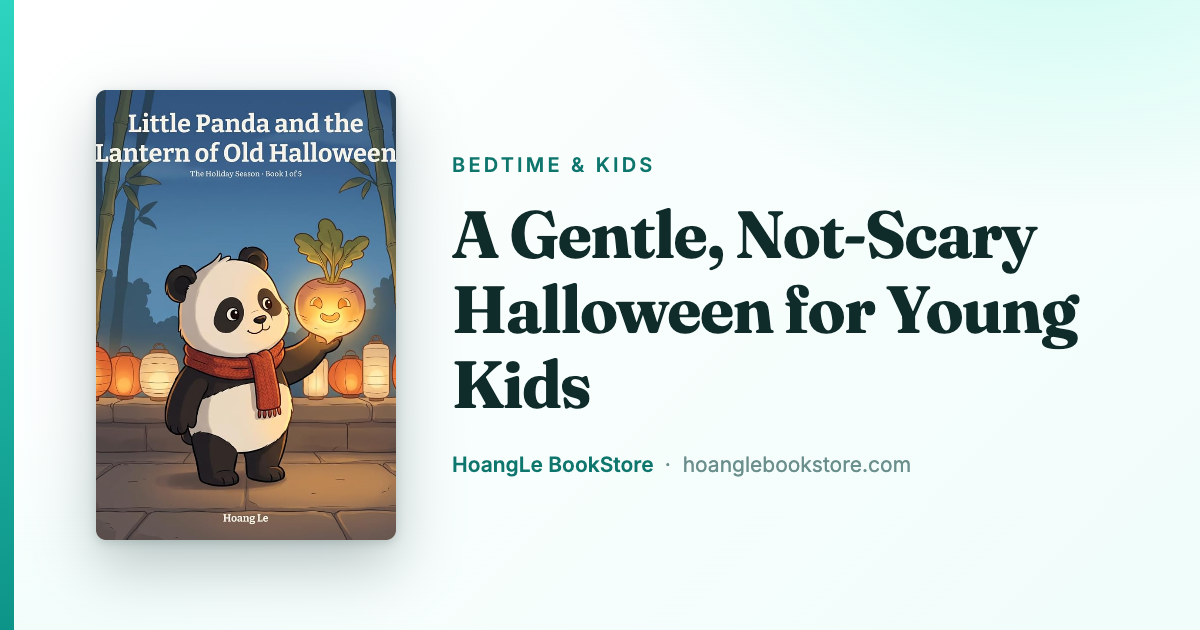
Halloween can feel like an all-or-nothing choice for parents of a young child. Either you skip it, or you brace for skeletons in the yard next door and a costume aisle built almost entirely around how frightening a four-year-old can be convinced to look. There is a third option, and it is actually the older one: a Halloween built around lanterns, songs, and a treat you earn by trying, rather than a costume meant to make someone jump.
Where the scary parts actually came from
Most of what reads as "spooky" about Halloween today is a layer added much later. The night itself started as Samhain, a Celtic marking of the year's turn: the end of the harvest and the start of the darker half of the year, kept with bonfires and gathering rather than gore. Before pumpkins, there were turnips, hollowed out and carved by hand into lanterns, which is a slower, funnier, far less dramatic image than anything sold in a costume shop in October. And before candy was something bought in bulk, it was something earned: a child went door to door and had to do something first, a song, a joke, a short poem, a custom called guising. None of that requires a single monster.
A guising night instead of a scare night
Little Panda and the Lantern of Old Halloween builds its whole Halloween around that older, gentler version. A visiting friend from Scotland explains where the night comes from, the two of them carve a turnip lantern the hard way, bob for apples, and work out why a performance earns a treat. A second character, Panda the Scholar, plays a specific role throughout: the visiting friend explains what people used to do, and the Scholar is the one who explains why, which keeps the history from turning into one long lecture delivered by a single voice. By the end, Little Panda holds a guising night of his own, lanterns lining a stone path, a joke or a short poem traded for something sweet at every door. The closest the story comes to a scare is a quiet moment where Little Panda realizes his own costume has frightened someone smaller than him, and changes it before the night goes on. That is the whole lesson tucked inside the fun: Halloween is not a contest over who can be the scariest. It is a night about who you might be making nervous without meaning to, and what you do once you notice.
Three ways to keep it gentle at home
You do not need the book to run a version of this at home, though Little Panda and the Lantern of Old Halloween gives a young child the whole idea in story form before the night itself arrives. A few pieces of it travel well off the page.
Let a costume mean delight, not disguise. Ask who your child wants to make smile, not who they want to scare. A favorite animal or a color they love does the job without a single fright.
Build in something small to earn. A joke for a grandparent, a short song for a neighbor, a drawing handed over at the door: the guising instinct, that a treat follows a bit of effort, is what makes the night feel earned instead of just collected.
Tell the history as a story, not a warning. Turnip lanterns and bonfires marking the turn of the seasons make for a far easier bedtime conversation than ghosts, and they are also the truer version of where the night actually began.
These three ideas work with no book in the house at all, but having one that walks through them in order makes the first attempt easier. A child who has already watched Little Panda try a joke at one door, wobble, and keep going anyway, is more willing to try the same small performance themselves at an actual neighbor's door.
None of this asks a family to opt out of Halloween. It asks for a version sized to a four-year-old instead of a haunted house: lanterns over fright, a song over a jump-scare, and a treat that was earned rather than simply handed over.